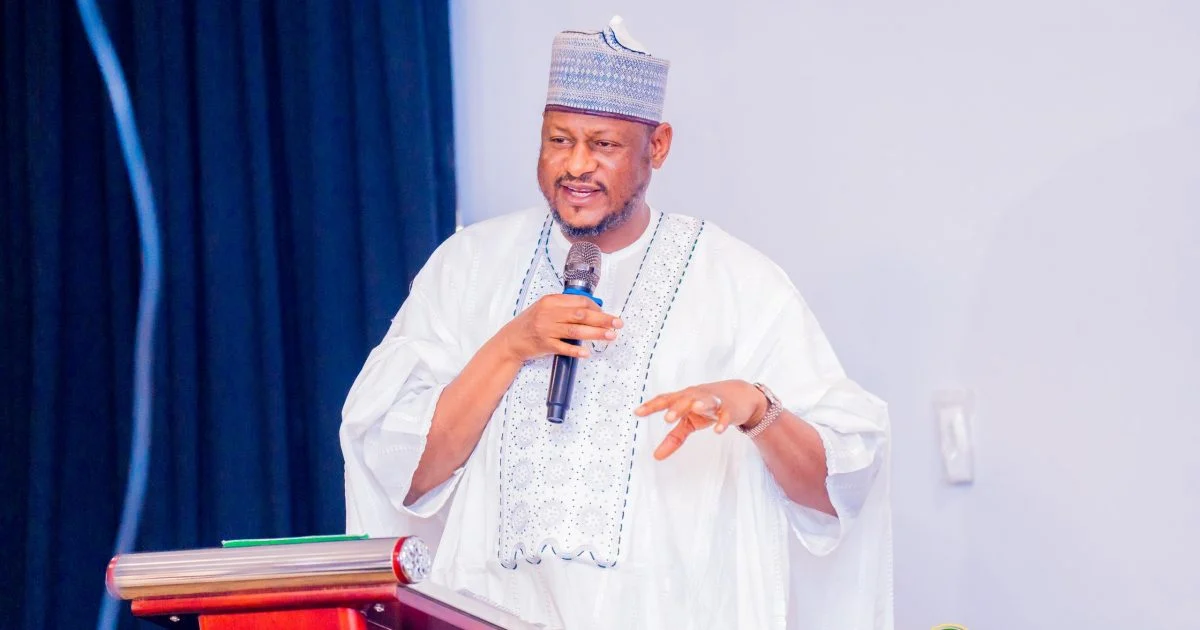
The Katsina State Governor, Dikko Radda, has attributed the failure of states in the North-west region to establish security outfits modelled after those in some South-west states (Amotekun) to a lack of political consensus among the region’s governors.
Mr Radda stated this in an interview with Radio France Internationale (RFI) Hausa, a clip of which was obtained by PREMIUM TIMES after the RFI shared it on Monday.
The governor’s admission offers a rare glimpse into the cracks within the Northern Governors’ Forum, arguably explaining why banditry continues to plague the region despite isolated efforts by individual states.
‘Isolated Efforts Won’t Work’
Speaking on the operational challenges of fighting insecurity, Mr Radda lamented that without a simultaneous, region-wide offensive, state-level efforts are insufficient.
“In our consultations with the governors… we agreed it was imperative to adopt a unified strategy to bring security to our region,” Mr Radda said. “We understood that if we address security in Katsina but ignore the Zamfara axis where we share a border, the effort would not succeed.”
He explained what he described as a “displacement effect” in the fight against armed groups.
“If Zamfara acts and Katsina does not, the effort will not succeed as intended… Similarly, if Zamfara, Sokoto, or Kebbi do not act, there is a problem.”
Failing Agreement
Despite this understanding, a unified force was never realised among the governors. Mr Radda revealed that when Katsina moved to establish its Community Watch Corps (CWC), not all neighbours were ready to move at the same pace.
“At that very moment, when other governors saw what we were doing, they came and adopted the law we established… like Zamfara and Sokoto,” he noted.
However, he hinted at frustration with other states that dragged their feet.
“Some governors did not do it because they felt it might not be the right time for them, or perhaps they did not feel the urgency of the circumstances we were facing. It is for this reason that you see we did not establish a unified North-west regional security corps.”
The governor rejected claims that the North is only now reacting after the states in the South-west established their regional security structures.
“Just as many people are saying that the South-west established their corps recently… before they established theirs, people should recall that… it has been five months since I established this corps,” he said.
Many states in the Southwest, including Ondo, Osun, and Oyo, have established state-run security agencies, generally called Amotekun, which have a primary responsibility of tackling armed criminals, such as bandits and kidnappers. The existence of the security agencies is believed to have contributed to the relatively low level of banditry in the region.
Timeline Discrepancy
While defending his administration’s stance, Mr Radda claimed in the video that it had been “five months” since he established his corps.
However, checks by PREMIUM TIMES indicate that the Katsina Community Watch Corps was officially launched over two years ago, on 10 October 2023, followed by the graduation of a second batch of operatives in November 2024.
The governor may have been referring to the recent operational expansion or the graduation of the latest batch of recruits.
He also disclosed that Kano State is set to launch its own outfit “next week,” a move he hopes will finally pave the way for the synergy that has been missing.
States in north-west and north-central Nigeria suffer from intense banditry, where armed groups attack communities, travellers and security officials at will. Katsina is one of the most affected states by the attacks that have led to the killing and kidnapping of thousands of people in recent years.
Defending ‘Trickle-Down’ Projects
Beyond security, the governor also utilised the interview to defend his administration’s spending on capital projects amidst economic hardship.
Responding to critics who argue that infrastructure does not alleviate immediate hunger, Mr Radda argued that construction projects are a vital mechanism for wealth redistribution.
“If you want money to cascade down… when you execute a capital project, you are creating jobs,” he argued. “You are bringing money down to the people.”
He argued that labourers, food vendors, and suppliers benefit directly from these projects, preventing the local economy from “standing still.”
“If you go to the local government areas in Katsina State today, you will see a hive of activities… simply because the funds have reached the community,” he said.